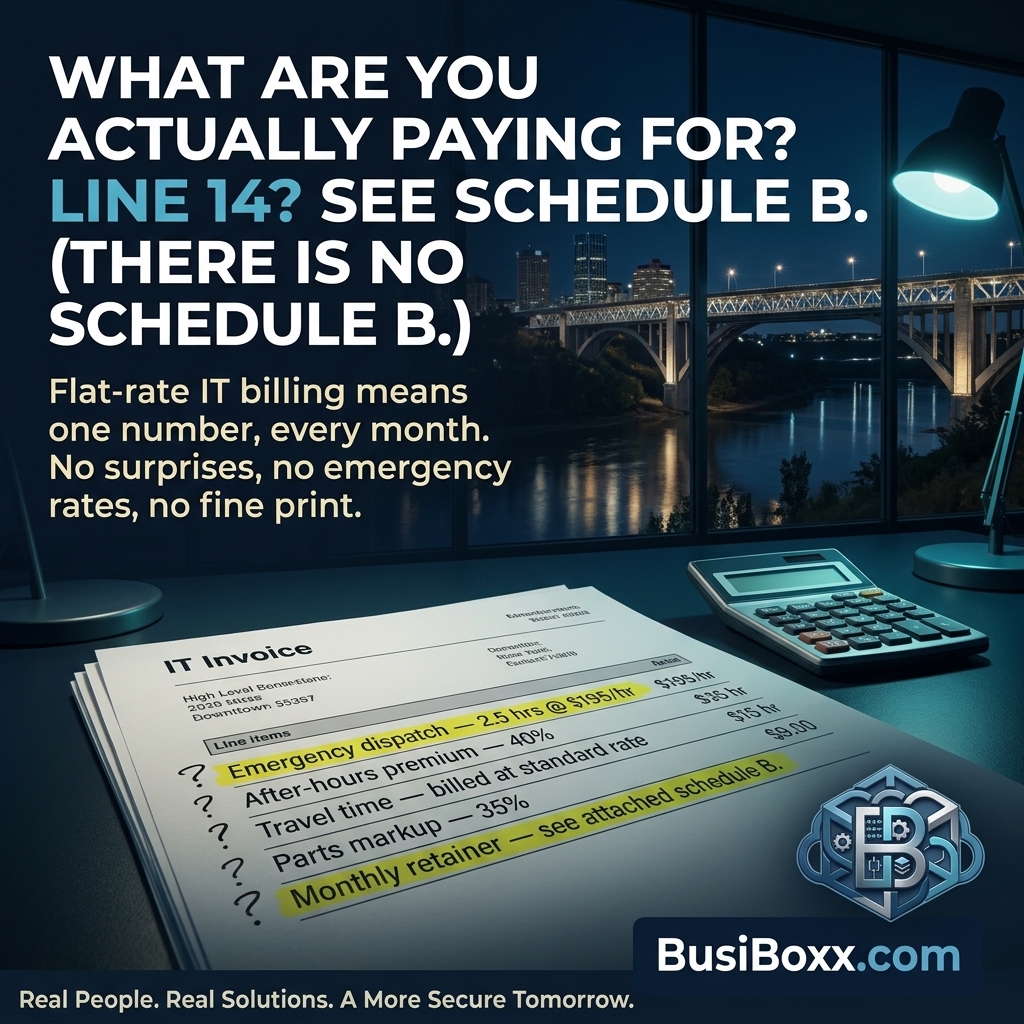
Forty-three line items.
Hourly rates. Partial-hour rounding. Travel time billed at 75%. A catch-all charge at the bottom — "Network Maintenance, $310.00" — that appeared on every invoice with a slightly different dollar amount and no description of what changed.
He'd been paying it for three years.
When he finally called to ask what the line was for, it took four emails and a phone call to get an answer that still didn't entirely make sense.
He wasn't being cheated. Not exactly.
He just had no idea what he was buying. And when he asked, neither did they, apparently.
Flat-rate vs. hourly: the model matters
IT services are typically priced one of two ways:
Hourly (break/fix): You pay when something breaks and someone comes to fix it. No problem, no bill. This sounds like a good deal — you only pay for what you use.
The problem is the incentive structure. A break/fix provider earns money when things go wrong. The more things break, the more they bill. There's no financial incentive to prevent problems, document your environment proactively, or invest in your infrastructure's long-term health.
There's also the predictability problem. You can't budget for IT spend when the bill changes every month based on what broke. A bad month — a server failure, a virus, a migration — can mean a bill of $4,000 or $8,000 when you expected $600.
Flat-rate (managed services): You pay a fixed monthly fee for a defined scope of services. The scope typically includes monitoring, patching, helpdesk support, backup management, and vendor liaison. Everything inside the scope is covered. Clear extras are defined in advance.
The managed services model aligns incentives correctly: your provider earns the same amount whether your environment is stable or not. The less they have to do, the better the margin — which means they're motivated to keep things running well.
What you should own
Here's a question worth asking your IT provider today: if your company disappeared tomorrow, could I keep my business running?
Specifically:
Your credentials. Every admin password, every service account, every vendor portal login. These should live in a password vault that you control — not in your IT provider's vault where you may not be able to access them.
Your documentation. A network diagram, a list of your devices, your IP addressing scheme, your vendor contacts. Institutional knowledge shouldn't disappear when a provider relationship ends.
Your licences. Microsoft 365, antivirus, backup software — the licences should be in your name or your company's name. If they're under your provider's reseller account and the relationship ends, access can become complicated.
Your data. Backups should be in a storage location you can access independently. If your backup lives only in your provider's cloud environment, it goes with them if the relationship ends badly.
A good IT provider hands all of this over willingly. One who makes the question feel uncomfortable is one who wants you to need them.
What the invoice should actually tell you
Each line item on an IT invoice should describe:
- What was done
- When it was done
- On which system or user account
- Why it was done (scheduled maintenance, incident response, request)
"Network maintenance — $310" is not a line item.
"Firmware update applied to SonicWall TZ-370 firewall unit — scheduled quarterly maintenance — 45 minutes" is.
If you can't read your invoice and understand exactly what your provider did last month, that's not a billing problem. It's a service problem.
The question to ask before you sign anything
"If I needed to switch providers in 90 days, what would the handover process look like?"
A good provider has a documented answer. They've done it before, they have an offboarding checklist, and they don't make the question feel like a threat.
A provider who hesitates, changes the subject, or makes the question feel like a betrayal of the relationship is a provider who is counting on you never leaving.
That's not a partner. That's a dependency.